
Connect With Our Team


PERC vs TOPCon vs HJT Solar Panels: Buying Guide 2026
Jun 03, 2026
1881 View
PERC vs TOPCon vs HJT Solar Panels: Buying Guide 2026
Solar technology is moving fast. In 2026, three technologies dominate the global market: PERC solar panels, TOPCon solar panels, and HJT solar panels. Each comes with its own strengths, costs, and ideal use cases.
If you are an EPC contractor, industrial buyer, or project developer, choosing the right module is no longer just about price. It is about long-term energy yield, reliability, and return on investment. With rising energy demand and tighter project margins, selecting the right photovoltaic technology can directly impact profitability.
This guide breaks down everything you need to know, from efficiency to cost and real-world performance, helping you make a confident buying decision.
What Are PERC, TOPCon, and HJT Solar Panels?
PERC Solar Panels Explained
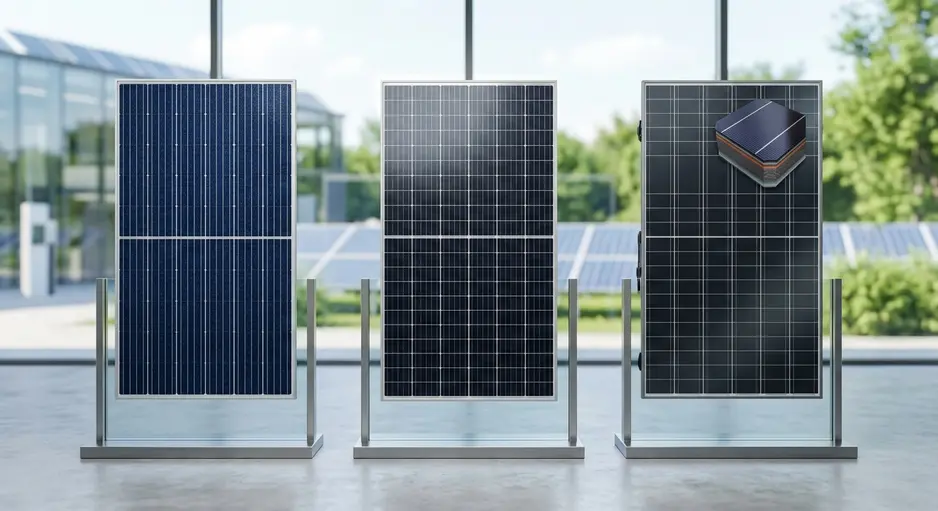
PERC stands for Passivated Emitter Rear Cell. It is an improved version of traditional monocrystalline solar cells. The added rear layer reflects unused sunlight back into the cell, improving efficiency.
PERC solar panels are widely used because they are cost-effective and easy to manufacture at scale. They are a strong choice for residential and small commercial systems where budget matters.
-
Efficiency range: around 20% to 21.5%
-
Lower upfront cost
-
Proven and reliable technology
TOPCon Solar Panels Explained
TOPCon stands for Tunnel Oxide Passivated Contact. This technology builds on PERC by adding a thin oxide layer that reduces energy loss and improves electron flow.
TOPCon solar panels offer higher efficiency and better long-term performance. They are becoming the preferred choice for commercial rooftop and utility-scale projects.
-
Efficiency range: around 21.5% to 23%
-
Lower degradation compared to PERC
-
Strong performance in varied climates
HJT Solar Panels Explained
HJT, or Heterojunction technology, combines crystalline silicon with thin-film layers. This hybrid structure allows for very high efficiency and excellent temperature performance.
HJT solar panels are considered premium modules. They are often used in high-efficiency photovoltaic modules for export and projects where space is limited but output must be maximized.
-
Efficiency range: around 22% to 24%
-
Very low degradation rate
-
High bifacial solar panel gain and superior heat performance
PERC vs TOPCon vs HJT Comparison 2026
Solar Module Efficiency Ratings Comparison
Efficiency directly impacts how much power you can generate from limited space.
-
PERC: ~20–21.5%
-
TOPCon: ~21.5–23%
-
HJT: ~22–24%
For projects with space constraints, higher efficiency modules like TOPCon and HJT provide a clear advantage.
Degradation Rate: PERC vs HJT Panels
Degradation rate tells you how fast a panel loses performance over time.
-
PERC: ~0.45–0.55% annually
-
TOPCon: moderate degradation
-
HJT: as low as ~0.25%
This means HJT panels maintain output longer, which improves lifetime returns.
Temperature Coefficient Explained
The temperature coefficient shows how panels perform in heat. Lower values mean better performance in hot climates.
HJT panels perform best in high-temperature regions like India and the UAE. TOPCon performs better than PERC, making it a strong option for industrial rooftops exposed to heat.
Energy Yield Comparison TOPCon vs PERC
Energy yield measures total electricity generated over time. Even a small efficiency gain can lead to significant extra output in large systems.
TOPCon typically delivers higher yield than PERC due to better efficiency and lower degradation. In solar farms, this translates into stronger long-term ROI.
Price per Watt & ROI in 2026

PERC Solar Panels Price per Watt 2026
PERC remains the most affordable option. Prices are generally lower compared to newer technologies, making them attractive for budget-sensitive projects.
-
Lowest upfront investment
-
Widely available in the global market
-
Suitable for large-scale deployments with tight budgets
TOPCon vs HJT Cost Comparison
TOPCon sits in the middle range, offering a balance between cost and performance. HJT comes at a premium due to advanced manufacturing.
However, when you consider lifetime energy production, both TOPCon and HJT can deliver better value despite higher initial costs.
Total Cost of Ownership for Industrial Projects
For industrial users, the real cost goes beyond the purchase price. You must consider:
-
Maintenance needs
-
Performance degradation
-
Energy output over 25–30 years
Higher efficiency modules often reduce the total cost of ownership by generating more power with fewer panels.
Wholesale Solar Modules: PERC vs TOPCon vs HJT
In the B2B solar panel manufacturer, there is a clear shift. Buyers are moving from PERC to TOPCon for better margins. HJT is gaining traction in premium export markets.
Best Solar Panel Technology for Commercial & Industrial Projects
Solar Panels for Industrial Use
Factories and warehouses often have limited roof space but high energy demand. High-efficiency modules like TOPCon and HJT are ideal here.
Utility-Scale Solar Panel Technology Comparison
TOPCon is becoming dominant in large solar farms due to its balance of cost and performance. HJT is used in projects where maximum efficiency justifies higher investment.
Commercial Rooftop Solar Panel Solutions
Commercial rooftops need strong performance under varying conditions. TOPCon offers reliable output, making it a preferred choice for many EPC companies.
Renewable Energy Solutions for Factories
Industrial users are shifting toward clean energy systems to reduce costs and meet sustainability goals. Choosing the right module ensures stable energy generation and long-term savings.
Global Market Trends & Technology Adoption
Latest Solar Panel Technology Trends 2026
The industry is moving away from PERC toward more efficient technologies. TOPCon is leading adoption, while HJT is growing in niche markets.
Global Solar Panel Export Market Trends
Demand is rising across the global market. Buyers are focusing on high-efficiency photovoltaic modules for export to meet stricter energy targets.
B2B Solar Panel Suppliers & OEM Manufacturers
Solar panel OEM manufacturers are expanding production of TOPCon and HJT modules. This shift reflects global demand for better performance and durability.
Monocrystalline vs Bifacial Solar Panels
Bifacial modules are becoming standard in large projects. HJT panels, in particular, offer strong bifacial gain, increasing overall energy generation.
How to Choose the Right Solar Panel Supplier
Buy TOPCon Solar Panels Bulk Supplier Checklist
- IEC and UL certifications
- Performance warranty
- Proven supply chain capability
HJT Solar Panels Manufacturers
Look for manufacturers with experience in markets, consistent quality, and strong logistics support.
Expert Buying Tips
-
Match technology with your climate and energy needs
-
Balance upfront cost with long-term performance
-
Check warranty and degradation rates carefully
-
Plan for scalability in future expansions
-
Partner with reliable suppliers like Sunify Solar for consistent quality
Explore Advanced Solar Panel Technologies
Conclusion
As the solar industry evolves, investing in the right technology ensures better returns and long-term reliability. For businesses looking to scale or export, working with a trusted supplier like Sunify Solar can simplify the process and ensure consistent quality.
FAQs
1. Which is better: TOPCon or HJT solar panels?
TOPCon offers a strong balance of cost and efficiency, while HJT provides higher efficiency and lower degradation. The better choice depends on your budget and project goals.
2. Are PERC solar panels outdated in 2026?
PERC panels are still widely used due to their affordability. However, many new projects are shifting toward TOPCon for better performance.
3. What is the most efficient solar panel technology today?
HJT currently leads in efficiency, followed closely by TOPCon.
4. Which solar panel is best for industrial use?
TOPCon is often the best choice for industrial projects due to its balance of cost, efficiency, and durability.
5. What is the lifespan of PERC vs TOPCon vs HJT panels?
All three technologies typically offer a lifespan of 25–30 years, with HJT showing slower performance decline.
6. Do HJT panels perform better in hot climates?
Yes, HJT panels have a better temperature coefficient, making them ideal for hot regions.
7. What is the cost difference between PERC, TOPCon, and HJT?
PERC is the most affordable, TOPCon is mid-range, and HJT is the most expensive but offers higher long-term value.
Share this post :




Whatsapp Chatx
Hi! Click one of our representatives below to chat on WhatsApp or send us email to solar@sunifysolar.in

|
************** +91 81414 55503 |
