
Connect With Our Team


How to Calculate Solar Panel Requirement for Any Space
Dec 08, 2025
2899 View
How to Calculate Solar Panel Requirement for Any Space
Solar power is becoming the preferred choice for homeowners, businesses, and industries looking to reduce electricity bills and switch to cleaner energy. But before installing a solar system, you must determine one important element your solar panel requirement.
Knowing this helps you understand the system size you need, how many panels are required, how much space is needed, and what performance you can expect. A correctly evaluated requirement ensures maximum efficiency, long-term savings, and a reliable solar setup.
This detailed guide explains how to calculate solar panel requirement in a structured, step-by-step way exactly how professional solar companies evaluate it.
What Determines Your Solar Panel Requirement?
A solar panel requirement refers to the total number of panels and the size of the solar system needed to meet your daily energy usage. It depends on:
-
Your electricity consumption
-
The average sunlight hours in your area
-
The wattage of the solar panels
-
Type of installation (home, commercial, flat roof, solar plant)
-
Whether the system is on-grid, off-grid, or hybrid
Understanding your requirement ensures that the solar installation delivers enough power without oversizing or undersizing the system.
Why Proper Calculation Is Important
A wrong solar system size leads to poor performance, reduced energy production, or unnecessary expenditure. Proper calculation helps you:
-
Match the system output with your actual energy needs
-
Prevent energy shortages or overload issues
-
Plan roof space and installation structure
-
Choose the right inverter, battery, and panel wattage
-
Improve long-term efficiency and reliability
Accurate assessment ensures the system works smoothly for 20–25 years with minimal maintenance.
Step-by-Step Method to Calculate Your Solar Panel Requirement

To ensure clarity, here is the complete calculation process in an organized, easy-to-follow structure used by most professional solar installers in India.
Step 1: Identify Your Daily Electricity Consumption
The first step is to understand how much electricity you use in a day. This gives you the baseline for estimating how much solar energy you need.Your electricity bill shows your monthly consumption in units (kWh). Converting this into daily usage helps you determine the required system size.
This value becomes the foundation for all further calculations.
Step 2: Define Your Solar Energy Objective
Before calculating the number of panels, you must be clear about your purpose:
-
Do you want to completely run your home on solar?
-
Do you want partial solar support for essential appliances?
-
Do you want a backup system for power cuts?
-
Do you want to reduce bills with net metering?
Your objective influences the final solar system size, component selection, and installation design.
Step 3: Evaluate the Average Sunlight Hours in Your Location
Solar power production depends heavily on sunlight availability. Most regions in India receive 4 to 6 hours of effective sunlight daily, but it varies by season and geography.
The more sunlight your area receives, the fewer panels you need to meet the same energy requirement.Evaluating sunlight duration ensures your system is neither oversized nor underperforming.
Step 4: Select the Suitable Solar Panel Wattage
Solar panels come in different wattage capacities such as:
-
330W
-
440W
-
550W
-
600W+ high-efficiency panels
Higher-wattage panels produce more power and require fewer panels for the same system size.
Choosing the right panel wattage ensures:
-
Optimal rooftop utilization
-
Lower installation costs
-
Higher energy efficiency
-
Better long-term output
Good-quality PV panels also improve performance during cloudy weather and low-light conditions.
Step 5: Calculate the Solar System Size You Need
Once you know your daily consumption and sunlight availability, the next step is to determine the system’s total capacity.
This step ensures you select a system size that matches your requirement whether it's 1 kW, 3 kW, 5 kW, 10 kW, or larger.
A correctly sized system guarantees stable power output and maximizes the return on investment.
Step 6: Calculate the Number of Solar Panels Needed
After determining your system size, divide the total required watts by the wattage of the panel you choose.
This gives you the approximate number of panels your installation will need.
This step ensures clarity in:
-
Budget planning
-
Roof area planning
-
Structural alignment
-
Inverter and battery selection
Step 7: Assess the Space Needed for Installation
Different rooftops support different capacities. You must analyze:
-
Total available roof area
-
Shadow-free space
-
Panel orientation
-
Tilt angle
-
Obstructions such as water tanks, AC units, or trees
For example, high-efficiency panels require less space, making them ideal for compact rooftops or flat roof installations.
Proper space planning ensures your panels receive maximum sunlight, improving system efficiency.
Key Factors That Decide “How Many Solar Panels Do I Need?”
A correct calculation depends on several real-world conditions. Each of these affects the number of panels, system design, and final performance. Here are the major factors:
1. Daily Energy Consumption
Higher daily usage means a larger system size, while lower usage needs fewer panels.
2. Sunlight Availability
Regions with high sunlight hours require fewer panels for the same output.
3. Panel Wattage & Efficiency
Higher wattage and better efficiency reduce the total number of panels required.
4. Roof Direction & Tilt Angle
South-facing roofs with correct tilt offer the best energy output in India.
5. Shadow & Weather Conditions
Shadows from buildings, trees, or water tanks reduce output and increase panel requirements.
6. Type of Solar System Installed
On-grid systems require fewer components, while off-grid systems require batteries, affecting total sizing.
7. Future Energy Needs
If your usage will increase (EV charging, new appliances), you may need to account for future expansion.
These factors determine how efficiently your solar installation will perform throughout the year.
Solar Panel Requirement for Different Types of Spaces
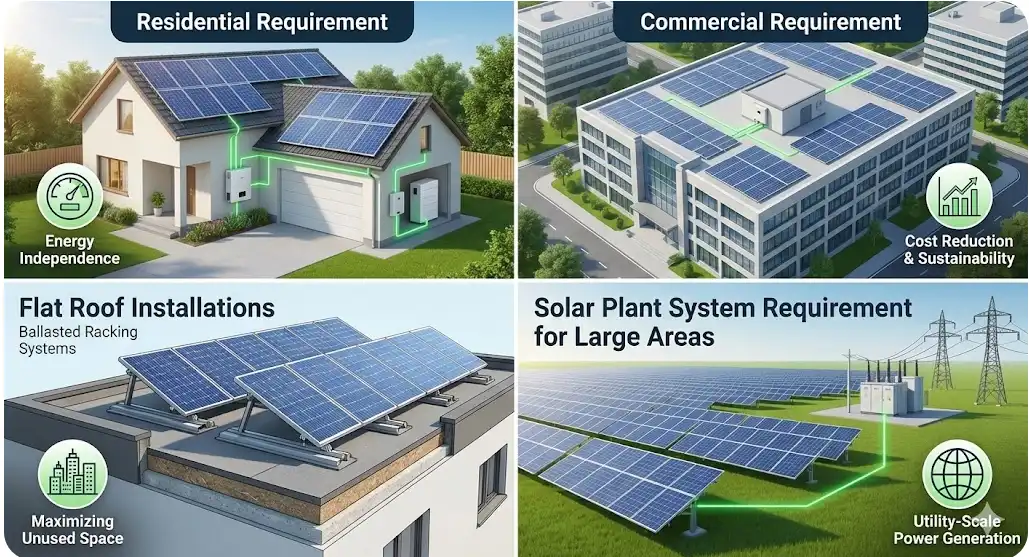
Residential Solar Panel Requirement
Homes usually require 2 kW to 5 kW systems depending on family size and appliance load.
Residential solar installations must focus on:
-
Compact, clean roof layout
-
Net metering benefits
-
Long-term bill reduction
-
Minimal maintenance requirements
A properly sized home solar system ensures consistent power and long-term savings.
Commercial Solar Panel Requirement
Commercial spaces consume more energy due to lighting, machinery, computers, and HVAC systems.Commercial installations range from 10 kW to several hundred kW depending on business type and load patterns.
These systems prioritise:
-
High-efficiency PV panels
-
Maximum rooftop utilization
-
Significant bill reduction
-
Business continuity
A commercial solar panel system requires precise sizing to support daily operational loads.
Solar Panels for Flat Roof Installations
Flat roofs offer installation advantages:
-
Panels can be aligned at the ideal tilt
-
Better air circulation for higher efficiency
-
More flexible layout planning
-
Suitable for medium-to-large systems
Solar panels for flat roof installations benefit from elevated mounting structures, ensuring consistent sunlight exposure.
Solar Plant System Requirement for Large Areas
Solar plant systems are designed for large-scale energy production often 1 MW and above.
Their sizing requires:
-
Land evaluation
-
Structural planning
-
High-efficiency large-format PV panels
-
Long-term performance forecasting
Solar plants serve industries, farms, educational campuses, and large commercial facilities.
Tools Used to Estimate Solar Panel Requirement
Manual Load Assessment
Professionals assess consumption patterns, seasonal usage, and peak load requirements.
Solar Panel Calculator Tools
Digital calculators help estimate system size, number of panels, cost, and savings.
Professional Site Survey
A site engineer conducts:
-
Roof inspection
-
Shadow analysis
-
Structural evaluation
-
Sun-path study
This is the most accurate method to calculate your solar panel requirement.
Common Mistakes to Avoid When Planning Solar Installation
-
Choosing wrong wattage panels
-
Ignoring roof shadows
-
Incorrect tilt or direction
-
Not accounting for future load increase
-
Selecting low-quality panels or inverters
-
Poor wiring or earthing
-
Installing panels too close, reducing airflow
Avoiding these ensures better output, fewer issues, and long-term reliability.
Checklist Before Installing a Solar PV System
-
Ensure roof is shadow-free and strong
-
Choose Tier-1 quality PV panels
-
Select the correct inverter type
-
Check warranty terms (panel + inverter)
-
Confirm net metering possibility
-
Ensure proper wiring and safety equipment
-
Work only with certified installers
A complete pre-installation checklist avoids future problems and maximizes performance.
Conclusion
Understanding your solar panel requirement is the foundation of a successful solar installation. When you accurately analyze your daily consumption, sunlight hours, panel wattage, and rooftop conditions, you get a system that is efficient, cost-effective, and future-ready. With proper calculation and planning, solar energy becomes a long-term investment that delivers savings and sustainability.
At Sunify Solar, we believe the right solar system begins with the right calculation. Our goal is to help homeowners and businesses choose systems that deliver maximum performance, year after year.
Share this post :



Whatsapp Chatx
Hi! Click one of our representatives below to chat on WhatsApp or send us email to solar@sunifysolar.in

|
************** +91 81414 55503 |
